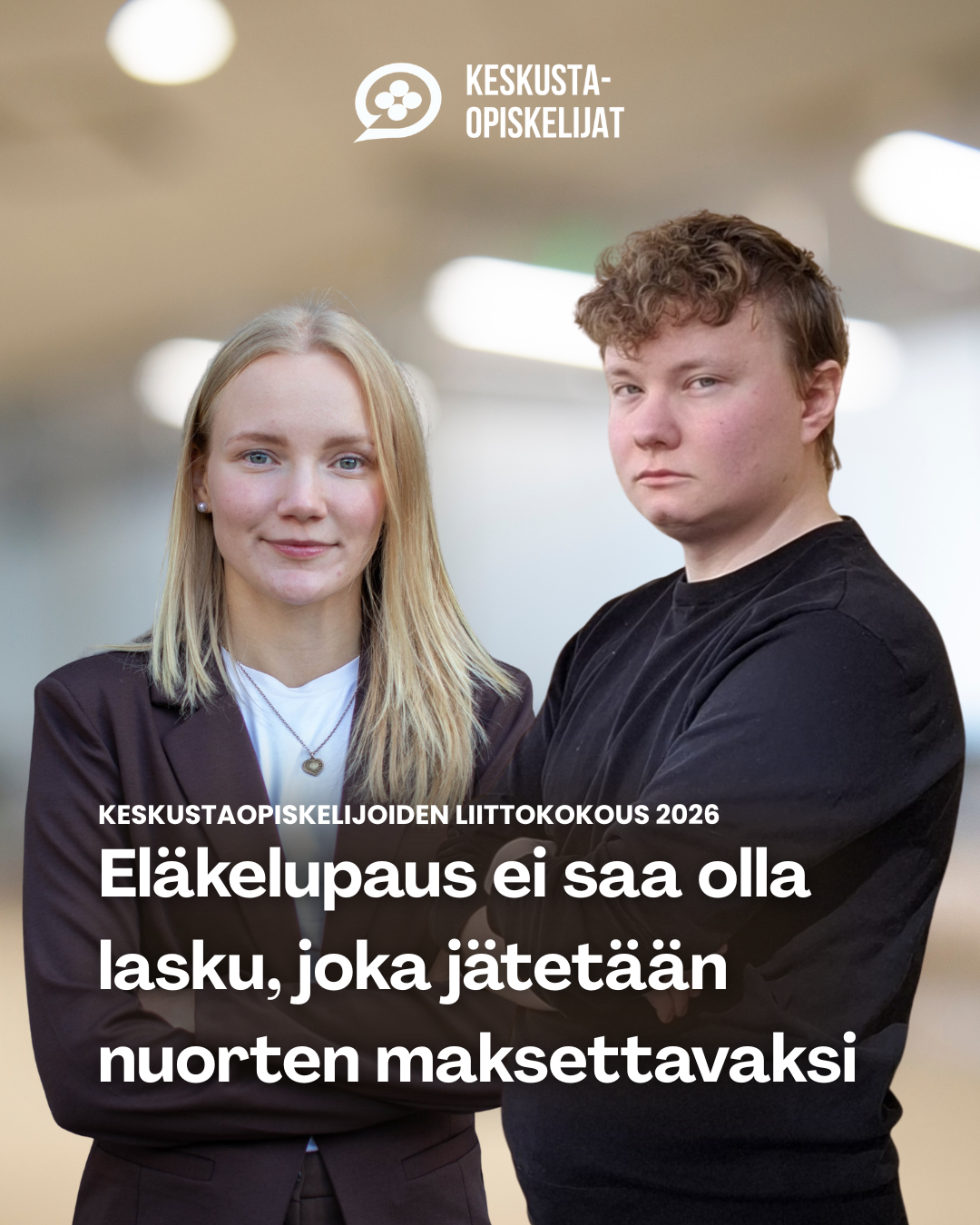
Finnish politics is marked by a curious double standard. Cuts can be made to students’ livelihoods, young people can be saddled with debt, and savings can be made at the expense of future services. But when the discussion turns to pensions, almost every proposal to make savings is treated as sacrilege. Centre Students therefore asks: Why is it considered responsible economic policy for young people to give up part of their future, while asking well-off pensioners to contribute to the shared effort is deemed unreasonable?
The Finnish pension system is based on solidarity between generations. People in work finance a significant share of today’s pensions, trusting that future generations will do the same in their turn. This social contract is sustainable only when fairness works in both directions.
Young people are expected to work longer, be flexible and be ready to shoulder the rising costs of an ageing society. At the same time, their opportunities to build wealth, buy a home and secure their financial future are in many ways more uncertain than before. The younger generations are being burdened with debt, responsibility and uncertainty, yet are expected to accept it all with gratitude. Fairness between generations cannot mean that one generation has benefits it has already secured while another has only obligations.
The pension reform strengthens the financing of the pension system, but leaves the question of fairness between generations unresolved. Seeking better returns on pension assets is justified, but the sustainability of the pension system cannot rest solely on expected returns in the investment markets. We also need the courage to discuss how the system’s costs and benefits are distributed between generations.
Centre Students calls for the position of pensions currently in payment to be considered as part of the reform of public finances and the pension system.
– It must be possible to limit index increases for the highest earnings-related pensions while safeguarding the purchasing power of the lowest pensions. In addition, every significant pension reform must include an open assessment of its effects on different generations. Young people’s perspective must have a genuine place in pension system decision-making, says Aapeli Rytkönen, 2026 chair.
This is not about setting pensioners against young people. Many pensioners in Finland have low incomes, and ensuring their livelihood is a duty of a society committed to education and welfare. But we must also recognise that a well-off pensioner’s livelihood is not automatically more deserving of protection than that of a student with a low income or a young person at the beginning of their working life. Pension policy must not be a politically untouchable area simply because pensioners are a large and active voting group. Politicians’ job is not to protect the interests of the most influential age groups at any cost, but to build a fair society for those who are not yet at the decision-making table, too.
– Centre Students reminds us that solidarity between generations is not a one-way obligation. We young people are ready to do our part for the future of the welfare state, but we will not accept that responsibility means endlessly giving up our own opportunities, says the newly elected chair for 2027 Josefina Tuomala.
A social contract in which one generation receives the promises and another gets the bill is not a fair contract. It is an imposition. Finland’s future cannot be built on the privileges of the past. It is time for pension policy that can stand up to scrutiny from future generations as well.