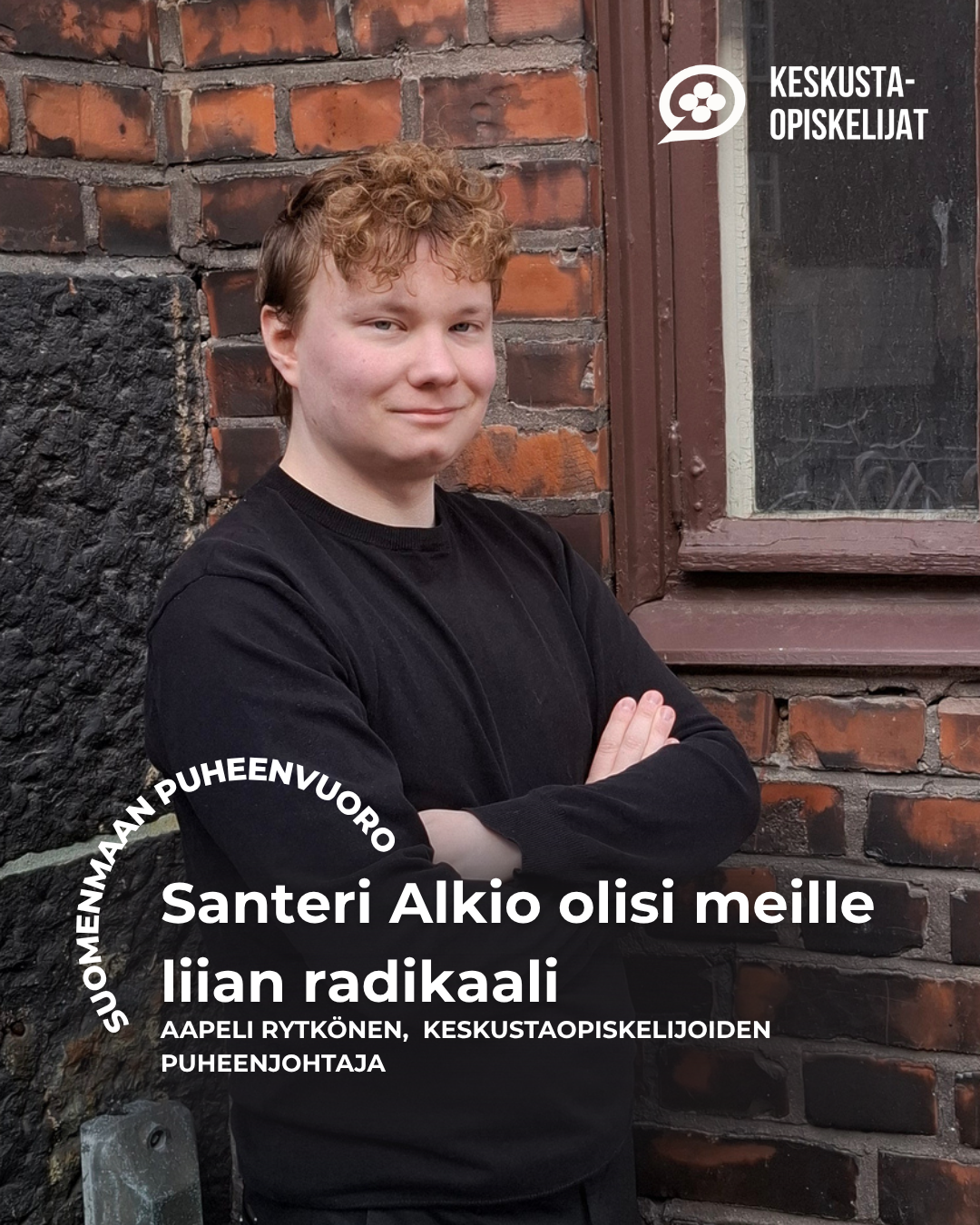
Santeri Alkio walks into a meeting of a local Centre Party association and proposes that society’s structures must be reformed, the position of the poor improved, and human development placed at the very heart of politics.
Silence falls over the meeting room.
Someone points to economic realities. Another considers the ideas far too radical. A third suggests setting up a working group. Finally, the chair thanks everyone for the constructive discussion and concludes that there is simply no political room for reforms of this magnitude right now.
Alkio leaves the meeting. And we are left wondering why the Centre Party no longer inspires people.
The scene is, of course, fictional, but the question it raises is real: have we made the founding figure of our own ideology too radical for today’s Centre Party?
Santeri Alkio did not build a political movement so that future generations could gather once a year to reminisce about what wonderful ideas he had.
He wanted to change the world.
Yet we in the Centre Party have a peculiar way of relating to our history. We have elevated Alkio’s name into ceremonial speeches, hung his portrait on meeting room walls, and placed his ideas in the introductions to party programmes. But at the same time, we risk forgetting that Alkio was not a contented defender of the social order of his time. He was its challenger.
Alkio did not establish a museum. He helped build a movement for social reform.
Centrism is often associated with moderation, reconciliation and compromise. These are valuable ways of practising politics, but they do not constitute an ideology in themselves. Moderation tells us how politics is conducted, not why it is conducted.
If the greatest virtue of a political movement is that it never offends anyone, what purpose does that movement ultimately serve?
The Centre Party must not allow others to define what it dares to say or what kind of society it is allowed to aspire to. Simply following others is not cooperation, and remaining silent about one’s principles is not responsibility. If the boundaries of our politics are determined by what our opponents expect of us, we have already lost the battle of ideas before it has even begun.
Alkio’s legacy does not oblige us to think as people did a hundred years ago. It obliges us to think just as boldly today.
That means standing up for the poor, making education and personal development accessible to all, and having the courage to challenge unjust structures. It also means recognising that young people have the right to demand more than merely managing the status quo.
Not every new idea needs to be accepted. But an ideology that no longer dares to renew itself gradually becomes a monument to its own past.
The Centre Party does not need to return to Alkio’s time. It needs to rediscover Alkio’s courage.
Because the saddest thing would not be if Alkio considered today’s Centre Party too moderate. The saddest thing would be if we ourselves considered his ambition to transform society too radical.
Aapeli Rytkönen
Chair of Centre Students