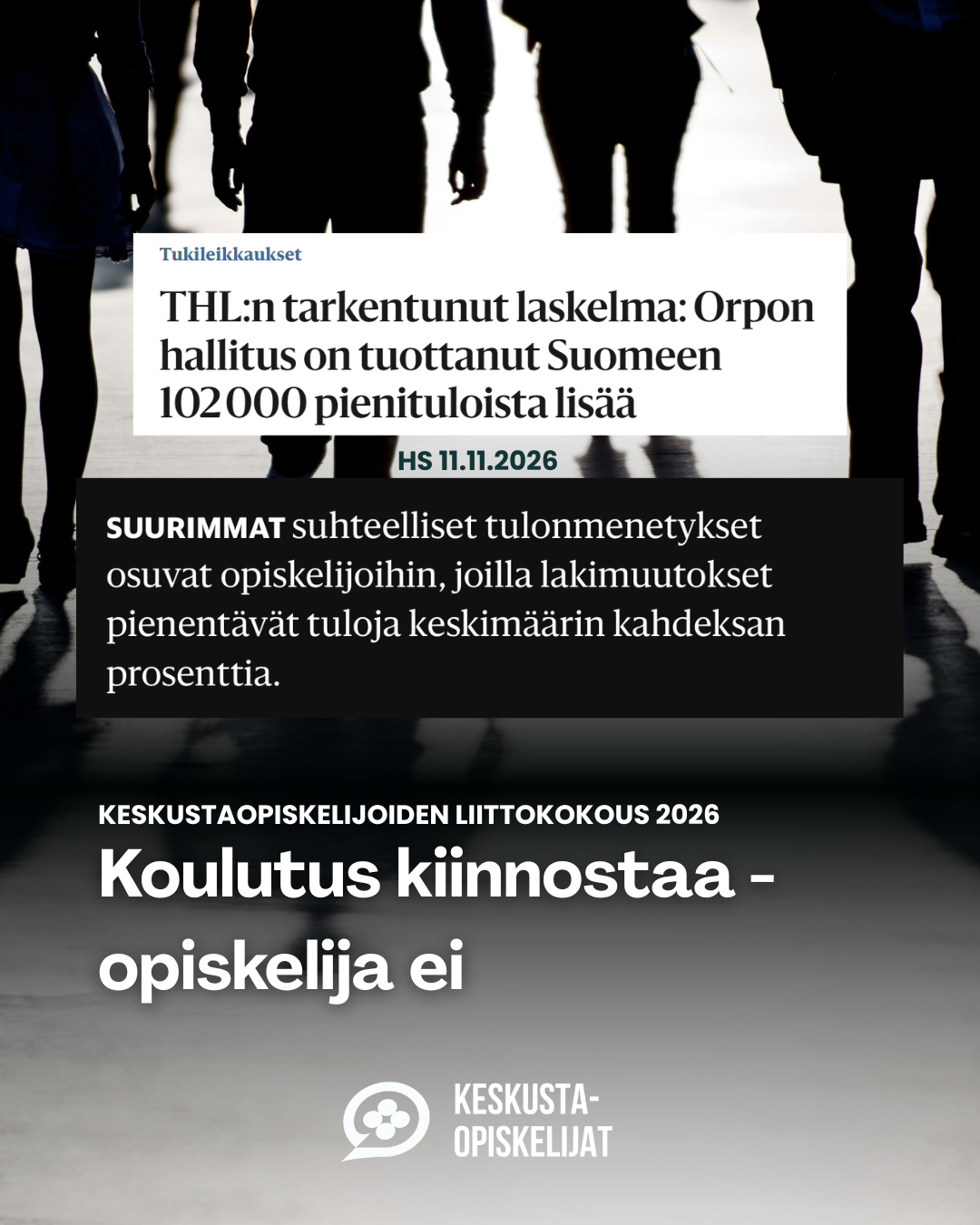
Finnish politicians love education. At least in their speeches. Education is an investment in the future, learning and culture are the foundation of the welfare state, and skills are Finland’s most important competitive asset. Politicians are happy to draw up endless strategies, programmes and reports on raising the level of education. But when the conversation turns from education to students, their political enthusiasm tends to fade.
Education matters, but students don’t.
Finland aims to raise the share of young adults with higher education qualifications to 60 per cent by 2040. There is still a long way to go. Yet political debate seems far more interested in the number of graduates than in the conditions in which degrees are earned. Student financial support has been weakened, student aid has become more loan-based, and students’ ability to cope has become a constant cause for concern. At the same time, students are expected to graduate faster, take a more active role in working life and assume ever greater responsibility for financing their own future.
Students are expected to graduate as quickly as possible, gain work experience, build networks, take part in society and preferably start a family, too. They are expected to do all this while many are constantly trying to balance work, studies and financial uncertainty just to get through everyday life. When that equation proves impossible, the problem is seen as the student’s time management rather than the unreasonable expectations society has placed on them. Finland wants more people with higher education qualifications, but does not seem willing to take responsibility for ensuring that someone can actually study for those degrees.
- Centre Students is particularly concerned that political debate has reduced students to factors of production in the national economy. A student’s worth is measured in credits, time to graduation and future tax revenue. Education is discussed as an investment that should produce as much as possible, as quickly as possible. This way of thinking forgets the most important starting point of education: a student is a person, not a unit of output moving through a degree factory, says Aapeli Rytkönen, the 2026 chair.
Learning and culture cannot be created in a spreadsheet. They grow through learning, reflection, failure, discovery and the opportunity to develop as a person. The purpose of higher education cannot be merely to produce new workers for the labour market as efficiently as possible. It must also help people become critical thinkers, active members of society and architects of their own future.
According to a recent student survey, almost one in three higher education students faces serious financial difficulties. When students’ everyday lives look like this, it is downright grotesque to talk about ambitious education targets without equally ambitious goals for student wellbeing.
Centre Students calls for student income, wellbeing and opportunities to focus on studies to be placed at the heart of education policy. Student financial aid must be adequate, access to mental health and student healthcare services must be improved, and higher education institutions must be given sufficient resources to provide high-quality teaching and guidance. The success of education policy must not be measured solely by the number of degrees awarded and how quickly students graduate, but also by the conditions and wellbeing with which students complete their degrees.
- We must also recognise that opening the doors to higher education is not enough to achieve equal access to education. If the opportunity to study depends on having wealthy parents, taking on years of debt or sacrificing your health, talk of equal opportunity is nothing but empty words, says Josefina Tuomala, newly elected chair for 2027.
Centre Students reminds decision-makers that raising the level of education and looking after student wellbeing are not separate political goals. They are two sides of the same coin. Without students, there is no education; and without students who are well, the skills on which Finland’s future is meant to be built cannot flourish.
We do not need another speech about the importance of education if the people delivering it are not prepared to defend the conditions that allow those who pursue it to live good lives. It is time to remind Finnish decision-makers of a simple truth: degrees do not earn themselves.