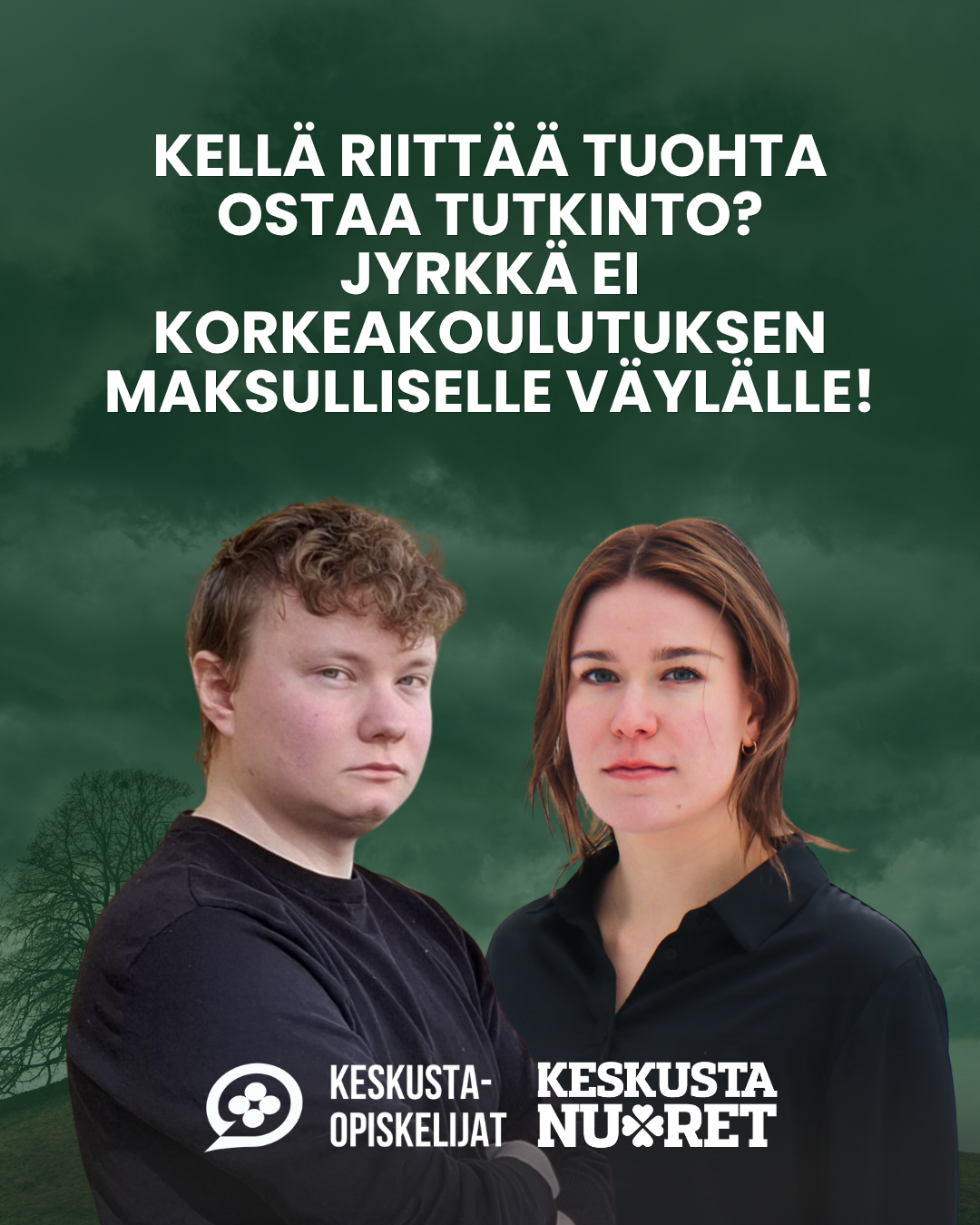
The Ministry of Education and Culture’s proposal would allow higher education institutions to offer fee-paying degree programmes through open higher education from 1 August 2028. The reform would apply to bachelor’s and master’s degrees at Universities, as well as to bachelor’s and master’s degrees at Universities of Applied Sciences.
Finland aims to raise the share of higher education graduates among 25–34-year-olds to close to 50 per cent by 2030. This is a goal worth supporting, but the government’s proposed means of achieving it—expanding fee-paying degree programmes through open higher education—does not address the key challenges facing Finland’s educational attainment.
“If we want to raise Finland’s educational attainment, we need to make higher education more accessible, not build new financial barriers on the path to a degree. A sustainable way forward is not to offer people who miss out on a study place the chance to buy a degree,” says Aapeli Rytkönen, Chair of Centre Students.
Finland’s problem is not a lack of desire to study, but too few places for new students in higher education. According to the OECD, the limited supply of study places is one of the main reasons for Finland’s low level of higher education attainment. In 2024, only 43 per cent of 18–24-year-olds applying to higher education for the first time were admitted. Raising educational attainment requires, above all, that more young people can begin higher education and receive the support they need from the outset to complete their degrees.
“Tuition-free education is one of the most important pillars of equality in Finnish society. Everyone should have the opportunity to pursue a higher education degree, regardless of their own or their family’s financial situation. Access to education must not depend on whether someone can scrape together enough money from their savings,” stresses Milla Veteläinen, Chair of the Centre Youth.
Centre Youth and Centre Students call for permanent, long-term funding to increase the number of places for new students, instead of creating a fee-paying shortcut. One-off increases are not enough: higher education institutions need predictable resources to recruit staff, develop teaching and permanently expand the provision of high-quality education. Continuous learning should be developed through work-oriented skills programmes and shorter qualifications separate from degree education, rather than by making full higher education degrees fee-paying. This would allow people to update their skills at different stages of life without compromising tuition-free degree education.
“Raising educational attainment is a political choice of values. The difficult state of public finances does not remove the need to invest in Finns’ skills and knowledge. If Finland wants to succeed in the future, we must stand by education even when the economy is struggling. Tuition-free higher education is not simply an expense for which we should seek new payers; it is a fundamental investment in Finland’s future,” the chairs conclude.
Further information:
Aapeli Rytkönen
Chair of Centre Students
+358 45 841 3580
aapeli.rytkonen@kol.fi
Milla Veteläinen
Chair of Centre Youth
+358 44 979 4321
milla.vetelainen@keskustanuoret.fi